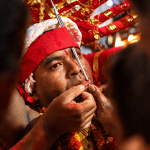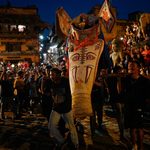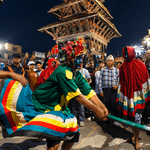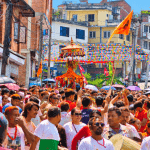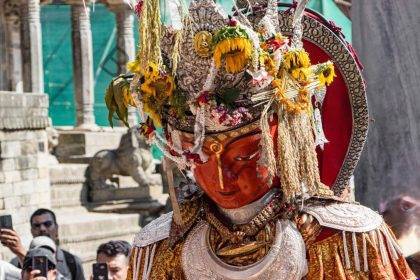

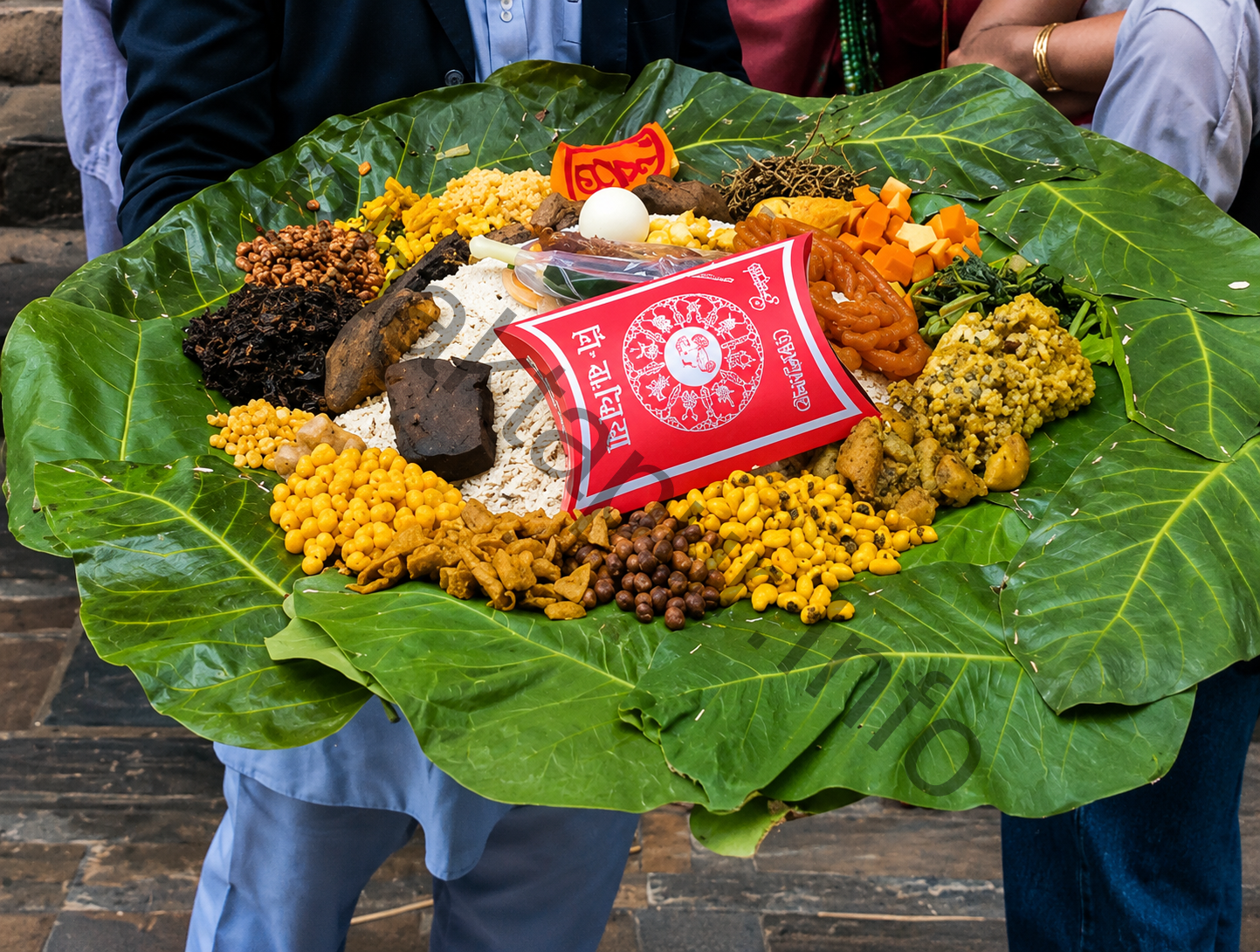

In Kathmandu Valley, especially Bhaktapur, is home to the traditional Newar religious and cultural activity known as Dyo Bwaykegu (द्यः ब्वय् केगु). In general, the phrase relates to cooking, presenting food to a deity, and hosting a feast for the god or goddess.
“Dyo Boyakegu” is a significant “intangible” cultural legacy. Navadurga Bhawani is welcomed into one’s original home with faith and a sense of grace, praying for happiness, prosperity, and good health, following the successful completion of any auspicious event, such as Bratabandha, Marriage, Ihi (Bel Vibah), etc. The custom illustrates the close ties that exist between religion, community, cuisine, and Newar social life.
श्री नवदुर्गा द्यः बोयेकेगु ज्याः झ्वः
Meaning of Dyo Bwaykegu (द्यः ब्वय् केगु)
The Newari expression can be understood through its individual words:
- Dyo (द्यः) – deity, god, or goddess
- Bway (ब्वय्) – feast, banquet, or special meal
- Kegu (केगु) – to do or perform
Dyo Bwaykegu (द्यः ब्वय् केगु) can therefore be broadly defined as “offering a ceremonial meal to the deity” or “holding a feast in honor of a deity.”

Religious Significance
Deities are revered in traditional Newar society as guardians of families, communities, neighborhoods, and cultural customs in addition to being objects of worship.
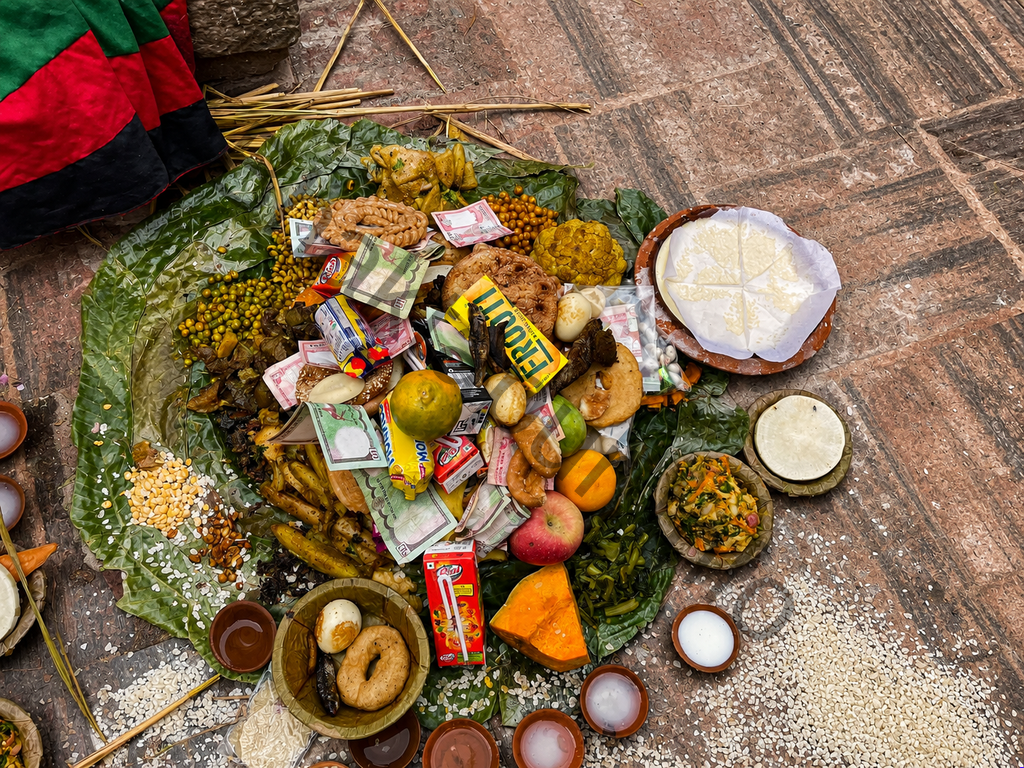
Food is cooked as part of a religious celebration on Dyo Bwaykegu (द्यः ब्वय् केगु). First, the deity is offered naivedya (ritual food offering) and worshiped. The food may be given out as prasad and shared among the participants following the religious ceremonies.
Depending on the god, region, family customs, guthi, and specific religious occasion, different rituals and offerings are made.
Traditional Newari Food
Food plays an important role in Dyo Bwaykegu (द्यः ब्वय् केगु). Depending on the occasion and local tradition, a ceremonial feast may include traditional Newari dishes such as the following:
- Chiura – beaten rice
- Samay Baji – a traditional Newari assortment
- Bara – savory lentil pancake
- Choila – spiced grilled or smoked meat
- Aloo Tama—potato and bamboo-shoot curry
- Bhatmas—roasted or seasoned soybean
- Traditional pickles and vegetables
- Dahi – yogurt
- Other locally prepared ceremonial foods
The menu is not necessarily the same everywhere. Different communities and religious groups maintain their own culinary traditions and prescribed offerings.

A Celebration of Community
The communal nature of Dyo Bwaykegu (द्यः ब्वय् केगु) is one of its most significant features. The ceremony and feast may bring together neighbors, family members, guthi members, and community members.
Food sharing provides a chance to improve friendship, teamwork, social ties, and a feeling of community. Additionally, it offers a crucial environment where elders can teach younger generations about customs.
In this sense, the feast is an expression of communal life rather than just a meal.
Connection with the Guthi Tradition
The preservation of Newar religious and cultural customs has been greatly aided by the ancient Guthi system. Guthi institutions are used in some communities to plan religious events, festivals, temple activities, and communal feasts.
Dyo Bwaykegu (द्यः ब्वय् केगु), which is practiced as part of these customs, illustrates the historical connection between religious obligations and communal cooperation in Newar society.
Dyo Bwaykegu in Bhaktapur
Bhaktapur is well known for its living Newar legacy, where religious rites, temples, festivals, guthis, and ancient neighborhoods continue to influence daily cultural life.
Dyo Bwaykegu can take on several forms depending on the location. Depending on local customs, there may be differences in the deity being worshiped, ritual process, scheduling, food offerings, and participants.
An essential component of Bhaktapur‘s cultural legacy is this diversity.
Cultural Importance
Three interrelated dimensions can be used to understand Dyo Bwaykegu (द्यः ब्वय् केगु) :
Religious Traditions
It is an offering offered in respect of a deity and a sign of devotion.
Heritage of the Community
It fortifies social ties and unites neighbors, families, and Guthis.
Culinary Traditions
It maintains ceremonial dining customs, traditional Newari cuisine, and cooking techniques.
Maintaining an Active Tradition
Dyo Bwaykegu (द्यः ब्वय् केगु) provides visitors to Bhaktapur with a glimpse of the city’s vibrant cultural legacy. Practices like communal religious feasts continue to be linked to the everyday and ceremonial life of local communities, in contrast to customs that are solely kept in museums.
It illustrates how Newar society continues to unite via faith, food, family, Guthi, and community.
A Quick Look at Dyo Bwaykegu
Dyo Bwaykegu (द्यः ब्वय् केगु) is not just a religious celebration. Devotion, traditional cuisine, community involvement, and Newar ancestry are all combined in this cultural activity. These customs help Bhaktapur become one of Nepal’s most significant living cultural attractions.